

I've spent over seven years working across quality assurance, product management, client relations, and technology. From video games and mobile applications to SaaS platforms and service-based products, I've had the opportunity to see quality from several different perspectives.
And one thing has remained consistent: the way we manage QA hasn't always kept up with the way we build products.
We have better technology, faster development cycles, more complex products, and higher expectations from users. Yet many QA teams still spend an unnecessary amount of time managing the process of testing rather than actually testing.
I believe that's one of the biggest opportunities for the next generation of QA tools.
The Problem Isn't Always the Testing. It's Everything Around It.
Anyone who has worked in QA knows that finding a bug is often the easy part.
It's everything that happens afterward that can become complicated.
Capturing the right evidence. Reproducing the issue. Documenting the steps. Communicating with developers. Tracking the fix. Retesting. Reporting progress to stakeholders.
Now multiply that across dozens of testers, multiple platforms, different environments, and competing release priorities.
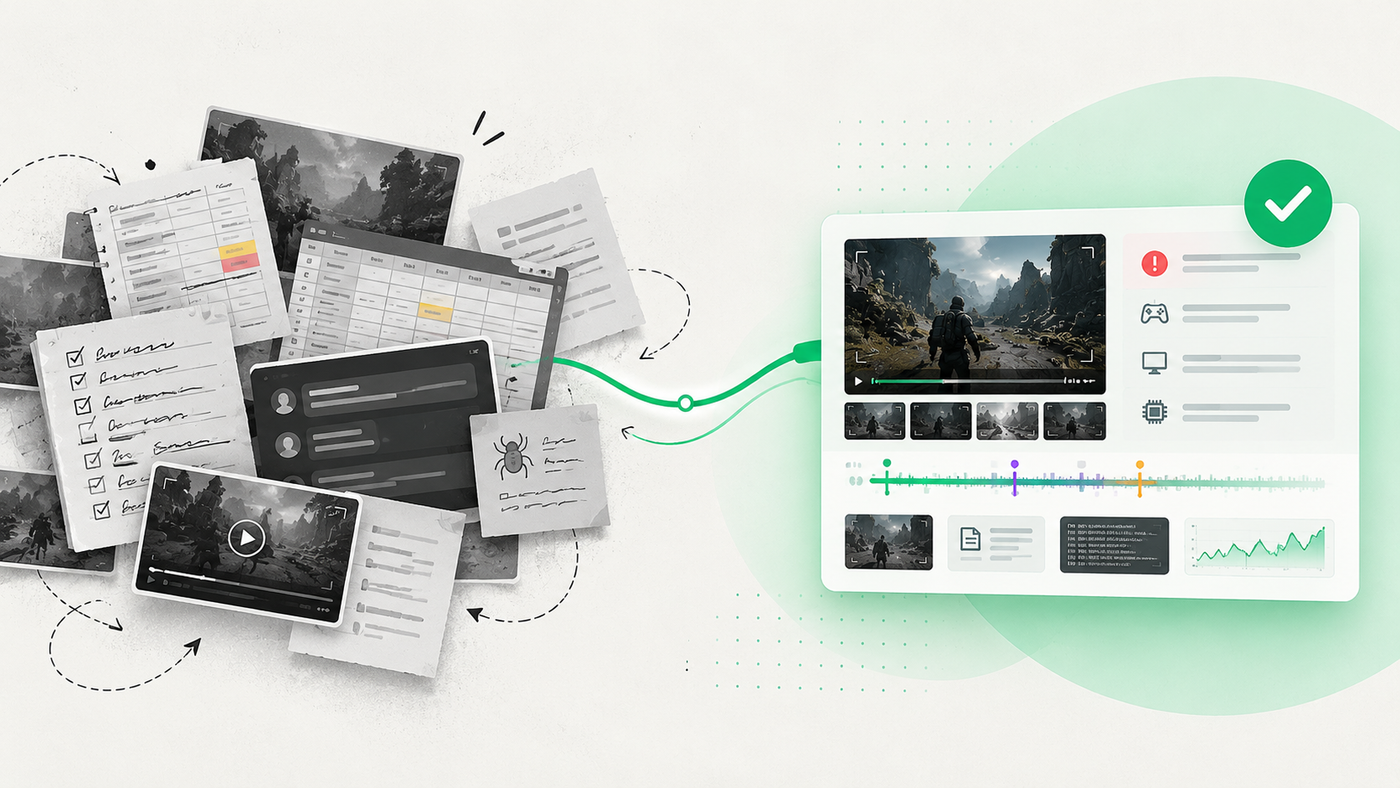
Suddenly, you're managing a collection of tools, spreadsheets, messages, and processes just to maintain visibility into what's happening.
I've worked on both sides of this, as someone executing tests and as someone responsible for building the strategies, processes, and reporting structures that keep testing organized.
And it's made me question how much of that administrative work should really be necessary.
Good QA shouldn't require more administrative work than actual quality assurance.
Games QA Has Lessons for the Wider Industry
Games are an interesting place to examine these challenges.
Games are complex, unpredictable, and incredibly demanding when it comes to performance, usability, and reproducibility. A single issue can depend on hardware, software, player behaviour, network conditions, or a particular sequence of events.
But the challenges games QA faces aren't exclusive to games.
A banking application needs reliable transactions. A healthcare platform needs dependable workflows. An e-commerce service needs a seamless customer experience. A SaaS product needs integrations that work consistently across environments.
Different products. Different risks. Different users.
But many of the underlying QA challenges are remarkably similar.
Every industry needs a way to capture what happened, understand why it happened, communicate the issue, and verify that it's been resolved.
This is one of the reasons I find the work we're doing with TopMod interesting. Although its foundations are in games QA, the problems we're looking to solve are part of a much broader conversation about software quality.
Evidence Should Tell the Story
One of the biggest challenges in QA is the gap between what a tester experiences and what a developer needs to reproduce.
A bug report might explain that a feature failed, but without the right context, developers can spend valuable time trying to recreate the conditions.
I've seen how much time gets lost in that back-and-forth.
The ability to capture meaningful evidence during testing, associate it with an issue, and make it accessible to the people responsible for resolving it changes that conversation.
Instead of relying entirely on written descriptions, teams have a clearer picture of the actual user experience.
And when that evidence can move through an organized workflow, rather than being scattered across different platforms, it creates opportunities for faster investigation and more informed decisions.
Better evidence doesn't just improve bug reports. It improves communication.
QA Is About More Than Finding Bugs
Something I've become increasingly passionate about throughout my career is the relationship between QA, product decisions, and operational efficiency.
QA shouldn't exist in isolation, and its value shouldn't be measured solely by the number of bugs discovered.
A strong QA function helps answer bigger questions.
Are we testing the right things? Where is our greatest risk? Are we ready to release? What is the actual impact on the user? Do our teams have the information they need to make decisions?
In my own work, I've developed risk-based testing strategies, managed regression coverage, coordinated testing across teams, and supported release-readiness decisions.
I've also seen how improving testing processes can produce measurable results, including reducing regression cycle time by 25% in a previous role.
That experience reinforced something I strongly believe: improving QA isn't necessarily about asking testers to work faster.
It's about removing the obstacles that prevent them from working effectively.
For me, that's where the conversation about QA tooling needs to move beyond individual features and towards how information flows between the people responsible for quality.
One Approach Won't Fit Every Industry
I don't believe there's a single testing strategy that works for every product.
A mobile game and a financial services application have very different risk profiles, regulatory considerations, and user expectations.
But they can benefit from many of the same operational improvements.
Centralized evidence. Clearer communication. Better traceability. More structured testing. Less duplication of effort.
A platform doesn't need to replace every specialized testing tool or industry-specific process to deliver value.
Its opportunity is to connect the work happening around testing, making information easier to capture, organize, share, and act on.
For QA leaders, that means better visibility. For testers, it means less friction. For developers, it means more actionable information.
And for businesses, it creates the potential for more efficient quality processes and greater confidence in release decisions.
The Future of QA Is Connected
I think we're entering an important period for quality assurance.
As development continues to accelerate, particularly with the growing adoption of AI-assisted development, the demand for effective validation isn't going away.
If anything, it's becoming more important.
The volume of work may change. The tools will evolve. The way we approach testing will continue to shift.
But the fundamental responsibility remains the same: ensuring that what we deliver actually works for the people using it.
Having worked across QA, product, and program delivery, I believe the next meaningful improvement won't come from simply adding more tools or asking teams to move faster.
It will come from better connecting the people, evidence, and processes that already contribute to quality.
The future of QA isn't just about finding bugs faster. It's about building a better system around quality itself.